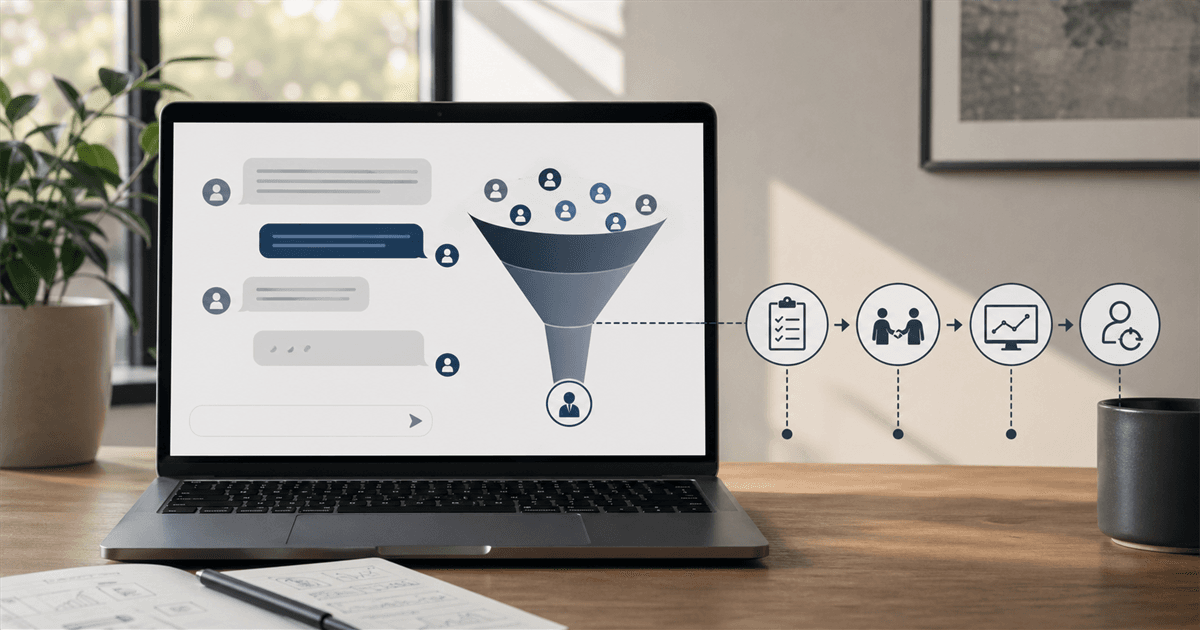
Custom GPTs created a wave of excitement for coaches, consultants, agencies, and service businesses. The pitch was obvious: build a GPT around your expertise, publish it, and let conversation turn into pipeline.
In practice, that usually does not happen.
Many custom GPTs are interesting to try, sometimes even impressive to use, but still weak at lead capture. They can answer questions, guide a conversation, and create a sense of personalization. What they often do not do is reliably collect structured qualification data, trigger the right next step, or give the business a clean handoff into follow-up.
That gap matters because a useful chat experience is not the same thing as a lead-capture system.
What People Expect a Custom GPT to Do
When businesses launch a custom GPT, they usually expect some version of the same outcome:
- attract the right people,
- answer early questions,
- qualify interest,
- collect enough information to identify a real opportunity,
- and move that person toward a booking, a contact form, or a sales conversation.
That expectation is reasonable. OpenAI now positions GPTs as purpose-built versions of ChatGPT designed for a specific task or workflow, not just as novelty chat interfaces. If you are a business owner looking at that framing, it is easy to assume a custom GPT can become a lead-capture asset with only light setup.
The problem is that most creators stop at the conversational layer.
They build something that sounds smart, feels custom, and reflects their expertise. But they do not build the workflow around the conversation. As a result, the GPT becomes a front-end interaction without a reliable lead path behind it.
Why Most Custom GPTs Fail at Lead Capture by Default
The first issue is visibility.
Even when a GPT is public, visibility alone does not equal conversion. OpenAI's current help documentation makes clear that public GPT pages may be visible without sign-in, but users still need to sign in before they can actually interact. That means the top of the funnel already has friction before your qualification flow even begins.
The second issue is that most GPTs have no built-in qualification structure.
A normal conversation can feel productive while still failing to capture the information a business actually needs. Someone may describe their problem in detail, but if the GPT is not designed to request specific fields, save them in a usable structure, and confirm completion rules, the result is still just a chat. You may have interest, but not a lead record.
The third issue is weak or missing handoff logic.
Even when a GPT does collect useful information, many setups do not define what happens next. There is no explicit path to:
- book a call,
- route the person into a CRM,
- send a follow-up,
- trigger an email sequence,
- or notify the business that a qualified lead exists.
Without that handoff, the GPT can create engagement without creating movement.
The fourth issue is poor tracking.
Many custom GPT experiences do not give the creator a clean, reviewable record of what happened. That means no clear answer to questions like:
- Who started?
- Who finished?
- What qualification data was collected?
- Where did users drop off?
- Which prompt or step caused confusion?
That is not a minor analytics issue. It is the difference between a business workflow and an expensive black box.
What Actually Makes a Custom GPT Useful for Lead Capture
A custom GPT becomes more valuable for lead capture when it stops being treated as a standalone chatbot and starts being treated as one layer in a larger system.
That system needs four things.
1. Structured qualification
The GPT should not just have a good conversation. It should collect the exact fields that matter for the next decision.
That might include:
- business type,
- problem category,
- urgency,
- budget range,
- current stack,
- readiness to buy,
- or desired timeline.
The key is not more questions. The key is better structure.
2. Clear handoff points
At some point, the GPT needs to stop chatting and move the person into the next business action.
That could mean:
- presenting a booking link,
- passing data into a form or workflow,
- triggering a sales or onboarding step,
- or sending the lead into a follow-up system.
If that moment is vague, optional, or inconsistent, conversion suffers.
3. Connected systems
OpenAI's current GPT documentation makes clear that GPTs can use actions or connected apps, and that these configuration choices affect what external workflow steps are available. That matters because lead capture is rarely finished inside the GPT itself. The business value appears when the GPT can connect to something outside the conversation.
The exact stack varies, but the principle does not. A GPT that cannot connect qualification to operational follow-through will underperform as a lead asset.
4. Follow-up logic
Lead capture is not just collection. It is continuation.
If someone completes a qualification flow and nothing happens next, the system has failed. Strong lead-capture workflows define what follows the conversation, who owns it, and what data moves forward.
A Conversational Tool Is Not the Same as a Lead-Capture Workflow
This is the mistake underneath most weak GPT funnels.
People confuse a capable conversational interface with a complete operating system.
A custom GPT can be good at:
- explaining,
- suggesting,
- diagnosing,
- summarizing,
- and guiding.
But none of those guarantee that the business ends up with a qualified, usable, trackable lead.
That requires workflow design.
This is the core contrast PacedLoop is built around. A GPT alone behaves like an open conversation. A structured workflow turns that conversation into a sequence of steps with explicit outputs, validation rules, and persistent artifacts.
That difference matters because lead capture is not just about what the AI says. It is about what the business can save, review, route, and act on after the interaction ends.
A Better Framework for Turning a Custom GPT Into a Lead Qualification Funnel
If you want a custom GPT to support lead capture more effectively, use this framework.
Step 1: Define the qualification artifact
Decide exactly what the GPT must collect before the interaction counts as a lead.
Do not settle for vague success criteria like "the user had a useful conversation." Define the saved output.
Step 2: Break qualification into stages
Do not ask for everything at once. Structure the flow so the user progresses through a small number of clear steps:
- context,
- problem,
- fit,
- readiness,
- next step.
That gives the conversation shape and improves completion quality.
Step 3: Add explicit completion rules
Each stage should have a clear completion condition. If required information is missing, the workflow should continue instead of pretending the step is done.
This prevents polite but useless outputs from being treated as qualified leads.
Step 4: Define the handoff event
Choose the exact moment when the GPT experience should move into booking, follow-up, routing, or internal review.
If there is no defined handoff event, there is no real funnel.
Step 5: Make the result reviewable
The business should be able to inspect what was captured without rereading a long transcript. That means storing qualification outputs in a structured, compact form rather than leaving them buried inside a conversation.
The Real Issue Is Not GPT Quality
Most of the time, the problem is not that the GPT is bad.
The problem is that the surrounding system is incomplete.
Businesses often expect a custom GPT to behave like a lead funnel, a qualification form, a CRM intake layer, and a follow-up engine all at once. But they only build the conversation. They do not build the operating logic around it.
That is why so many custom GPTs feel promising and still produce weak commercial outcomes.
The Better Question to Ask
Instead of asking, "Can a custom GPT capture leads?" the better question is:
Can this GPT move someone through a structured qualification flow that results in a usable next action for the business?
That is a much higher standard. It is also the standard that matters.
If the answer is no, then the GPT may still be helpful, but it is not yet a serious lead-capture system.
If you want lead capture to become reliable, the conversation needs a workflow behind it. That means explicit qualification steps, saved artifacts, operational handoffs, and follow-up logic that survives beyond the chat window.
That is where custom GPT novelty ends and business infrastructure begins.