Choosing a coaching niche is usually framed as a topic decision.
Should you be a career coach, an executive coach, a leadership coach, a transition coach, or a mindset coach?
That is not the wrong question.
It is just incomplete.
The deeper variable is not only what you coach on. It is who you choose to serve, and more specifically, the psychological and economic reality of that audience.
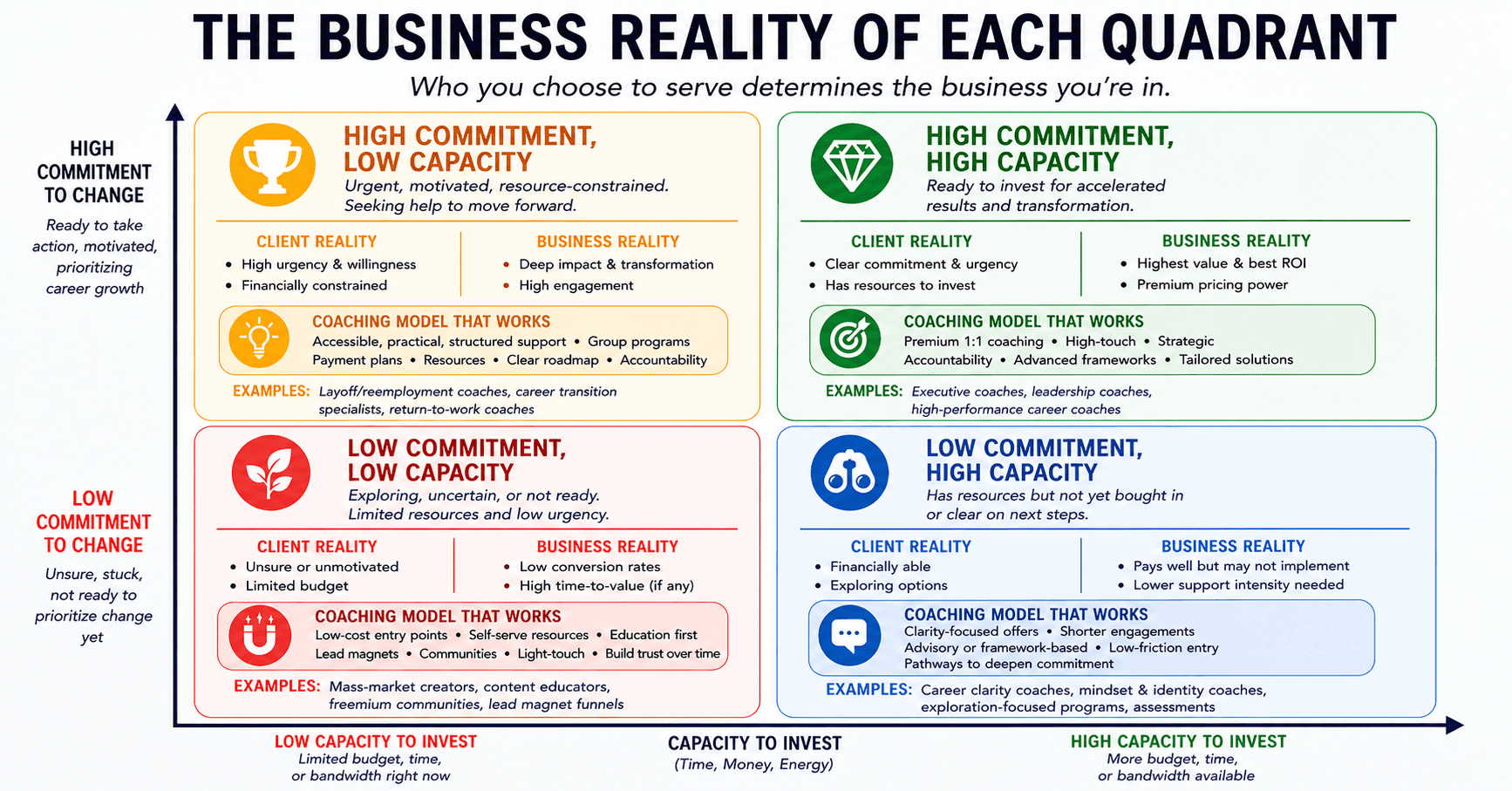
That is the idea behind the infographic for this article: The Business Reality of Each Quadrant.
Its central claim is simple: who you choose to serve determines the business you are in.
Two coaches can both sell "career coaching" and still operate fundamentally different businesses. One may serve laid-off professionals who are urgent, highly engaged, and financially constrained. Another may serve senior executives who want acceleration, discretion, and measurable outcomes. The category label sounds similar. The pricing, expectations, support burden, sales cycle, and delivery model do not.
That difference is what the infographic is designed to make visible.
The Two Axes Behind the Infographic
The framework uses two variables:
- Commitment to change: urgency, readiness, willingness to act, and follow-through.
- Capacity to invest: money, time, energy, and practical bandwidth.
Those two variables create four quadrants. Each quadrant tends to produce a different coaching environment:
- different pricing dynamics,
- different support expectations,
- different emotional intensity,
- different delivery structures,
- and different scalability constraints.
This is an original synthesis, not an official industry framework or academically validated model. That caveat matters. But the business dynamics underneath it are not arbitrary. They are strongly aligned with observable patterns in coaching markets and with how coaching literature discusses executive work, transition work, and scalable delivery structures.
In other words, the infographic should be read as a practical lens for thinking, not as a universal taxonomy.
How to Read the Storyline in the Graphic
The infographic is not just sorting people into categories.
It is telling a business story.
Each quadrant follows the same sequence:
- Client reality: what the client is psychologically experiencing.
- Business reality: what that tends to create for the coach.
- Coaching model that works: the delivery model most likely to fit those conditions.
That is why the graphic works so well as an article structure. It moves from psychology to economics to operating model.
If you want to choose a niche more intelligently, that is the chain you need to understand.
Quadrant 1: High Commitment, High Capacity
This is the premium quadrant in the infographic.
These clients are committed, outcome-focused, and able to invest. They usually have urgency, resources, and a clear reason to want acceleration.
In the image, this appears as the green quadrant: High Commitment, High Capacity.
The client reality here is straightforward:
- they want movement,
- they value leverage,
- they have resources,
- and they are buying support in order to produce meaningful results faster.
That client psychology tends to create the strongest pricing power.
It also creates a more demanding accountability environment. These clients are not usually paying for inspiration. They are paying for traction, perspective, strategic thinking, and measurable progress.
That pattern is strongly supported by the International Coaching Federation article on executive coaching, which frames corporate coaching around stakeholder complexity, organizational outcomes, and strategic positioning rather than simple hourly support. The article explicitly emphasizes measurable outcomes, alignment with business objectives, and delivery structures that fit corporate realities.
That matters because it reinforces one of the infographic's most important implications: some coaching audiences reward depth, precision, and premium delivery because their context already supports it.
This is why the coaching model in that quadrant tends to be:
- premium 1:1 work,
- high-touch accountability,
- strategic positioning,
- and tailored solutions.
Quadrant 2: High Commitment, Low Capacity
This is one of the most important parts of the infographic because it shows why a highly motivated audience is not necessarily the same thing as a premium market.
The orange quadrant, High Commitment, Low Capacity, captures people who are urgent, willing, and ready to act, but financially or practically constrained.
This is where layoff coaching, career transition coaching, and return-to-work coaching often fit.
The clients in this quadrant are not casual.
They are often deeply engaged because the problem is immediate. They want practical help, clear direction, and forward motion. But they may need payment flexibility, resource guidance, or more emotional support than higher-capacity audiences.
That combination can create some of the best transformation work and some of the heaviest support burden.
The Samaritan article on coaching types is useful here because it describes career transition coaching as practical, assessment-driven, and centered on helping people reposition themselves in the marketplace. That does not prove the full quadrant model on its own, but it does support the broader point that transition-oriented coaching often combines practical guidance with significant personal change pressure.
The infographic captures that tension well.
On the client side, these people are ready.
On the business side, they can require more hand-holding, more flexibility, and more emotional containment. So the correct coaching model is rarely just "charge more." It is often a more structured and accessible model:
- practical programs,
- payment plans,
- group support,
- accountability,
- and clear step-by-step roadmaps.
This is exactly the kind of nuance that gets lost when coaches choose a niche by topic alone.
Quadrant 3: Low Commitment, High Capacity
The blue quadrant is one of the most interesting and one of the most interpretive.
These people have resources but not urgency.
They are financially able, intellectually curious, and often actively exploring. But they are not always ready to implement.
This is where career clarity coaching, identity exploration work, mid-career reflection, and certain executive dissatisfaction cases can show up.
The infographic describes them as having resources but not yet being fully bought in or clear on next steps. That is a useful framing because it explains why this audience can look attractive from the outside while still creating uneven results.
They can pay.
They may not move.
That changes the business model.
Instead of heavy transformation delivery from day one, this quadrant often favors:
- clarity-focused offers,
- shorter engagements,
- advisory or framework-based support,
- assessments,
- and lower-friction entry points that deepen commitment over time.
This is the quadrant where the article should be most careful. The supporting citations do not map this segment directly in the same way they help with executive coaching or transition coaching. So this part of the infographic should be framed as an observed pattern rather than an established category.
That does not make it weak. It just means the claim should stay disciplined.
The practical insight is still strong: some audiences are premium in resources but exploratory in behavior, and that means the coach may need a different offer architecture than they would use with urgent buyers.
Quadrant 4: Low Commitment, Low Capacity
The red quadrant is the lowest-friction and highest-scale environment.
These people are curious but uncertain. They have limited budget, low urgency, and inconsistent follow-through. They often want inspiration, information, or a first step more than they want deep coaching engagement right now.
This is why the infographic points toward:
- self-serve resources,
- educational content,
- lead magnets,
- communities,
- and lightweight entry offers.
On the business side, this quadrant tends to create:
- lower conversion rates,
- higher sensitivity to price,
- lower ROI per client,
- and a stronger need for scalable systems.
The Anil Dagi article on coaching business models supports the broader logic here. It argues that business model decisions should match audience readiness, pricing reality, systems maturity, and delivery structure. It also makes the case that scalable and hybrid formats only work well when the outcome is repeatable and the operating model is designed for that audience.
That is the correct lesson for this quadrant.
If the audience is low commitment and low capacity, then education-first models usually make more sense than high-touch coaching. The job is not to force premium transformation onto people who are not ready for it. The job is to create low-friction pathways that build trust, clarify value, and let the right people move deeper when they are ready.
Why the Infographic Improves the Niche Conversation
Most niche advice for coaches stays too close to topic labels.
It asks whether you want to coach job seekers, founders, executives, women in leadership, burned-out professionals, people in transition, or people seeking clarity.
Those labels are useful.
But they are still surface-level.
The infographic improves the conversation because it asks a more operational question:
What kind of business does this audience naturally produce?
That question forces better thinking about:
- how easy it will be to price the work,
- how emotionally intense the work may become,
- how much support the client will need,
- whether the offer should be 1:1, group, hybrid, or self-serve,
- and what kind of scalability is realistic.
That is why the visual is not just decorative. It is the mechanism that turns the article's thesis into something easier to reason about.
The Real Strategic Insight
The biggest idea in the infographic is not that there are four boxes.
It is that the business model often follows the psychology and economics of the customer.
That is the insight many coaches miss.
They think they are choosing a niche by selecting a topic.
In reality, they are also choosing:
- a pricing environment,
- an implementation environment,
- a support burden,
- a sales cycle,
- an emotional climate,
- and a delivery model.
That is why two coaches can both say they help people with careers and still be building completely different companies.
A Better Way to Choose Your Coaching Niche
If you are choosing a niche, start with the topic if you need to. But do not stop there.
Ask:
- How urgent is this audience?
- How ready are they to act?
- What resources do they actually have available?
- What kind of support will they realistically need?
- What delivery model fits that reality?
- What kind of business do I actually want to run?
Those questions will usually tell you more than the niche label itself.
The article's infographic offers one practical way to think through those answers. Not because it is the final word on coaching segmentation, but because it helps translate audience psychology into business design.
And that is the real decision underneath niche selection.